
Every bus arrives with the diagnosis already done.
Stratio turns deep vehicle signals into a condition report before the bus reaches the workshop, so engineers can see the faults, the evidence behind it, and where to inspect first.
.webp)
The world’s leading public transport operators run Stratio





A fault code is not a diagnosis.
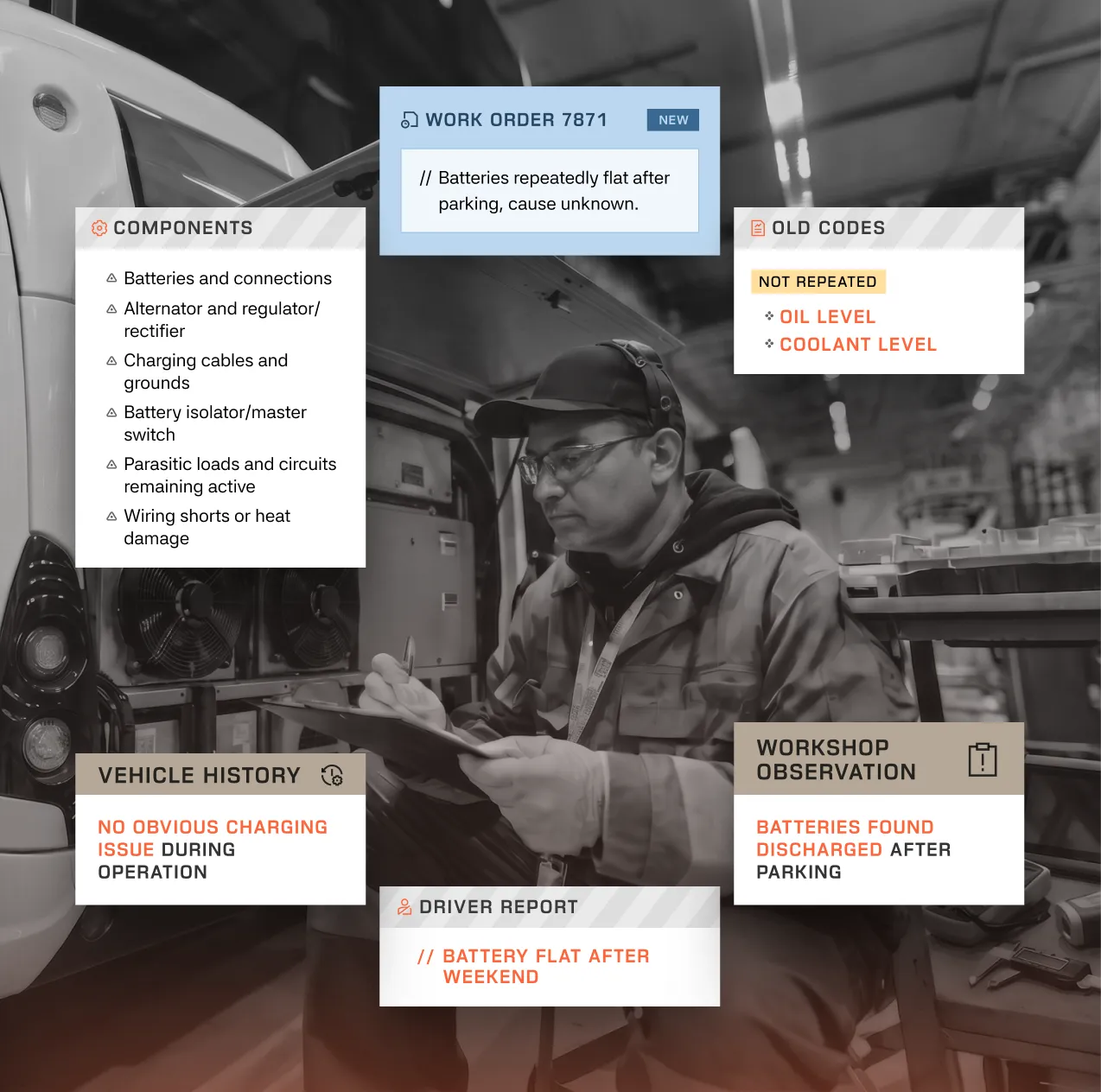


The diagnosis arrives with the bus.
Stratio continuously scans vehicle condition and connects fault codes, signal behaviour, maintenance history, and known failure patterns to identify what is actually happening. Each condition report shows the faults, the evidence behind it, and where the workshop should begin inspection.
.webp)


.webp)
From diagnosis to work order
Every developing issue becomes a condition report before the workshop starts investigating.
.svg)

.svg)


Condition reports are accessible directly in Stratio and can integrate seamlessly with your existing tech stack and maintenance workflow.
Less investigation, more time repairing.
.webp)

.svg)


SBS Transit: Every alert becomes a workshop task
SBS Transit use Stratio across their fleet. Diagnostic AI turns each relevant alert into a clear workshop task, so teams know what to fix when the bus comes into the workshop.
Teams see not just the fault, but the recommended steps - so inspections can go straight to repair.
.webp)
/// client testimonials
Real operators, real fleets. Real outcomes.
1 / 3


We adopted Stratio in 2020 to test whether failure prediction was real. The results speak for themselves: cost per km decreased, time between failures went up, and what began as a pilot in the Prague region is now a standard we keep expanding.
2%net savings per km operated
66.6%fewer towing interventions
33.3%improvement in planned-vs-unplanned maintenance ratio


The Stratio Platform enables real-time fault detection and predictions for our buses. This allows for timely repair recalls with the workshops being alerted before actual breakdowns happen, reducing the occurrence of bus breakdowns in the process.
20%Fewer bus
breakdowns
62%Of Singapore’s bus
fleet covered
3000+Buses running on Stratio


The Stratio solution, which is already deployed on several Keolis networks in France, allows maintenance staff to view and address vehicle failures. This eliminates costly downtime, enabling us to provide an even more reliable, efficient and safe service for passengers.


Stratio’s technology is enabling us to operate more efficiently, both in the workshop and in day-to-day operations by preventing bus failures and scheduling preventive maintenance at exactly the right time. This helps reduce costs while increasing vehicle availability. All of this translates into higher service quality, minimizing route disruptions and providing a safer and more comfortable driving experience.
.webp)
See how Stratio reduces workshop investigation
// Frequently asked questions
Have any questions? We’ll get back to you in 24 hours.
How is Stratio different from fault-code diagnostics?
A fault code is a snapshot: one threshold crossed at one moment.Stratio leverages far more data than the code alone, to tell the workshop what is actually happening, what caused it, and where to inspect first.
What does the workshop receive?
A condition report for each detected issue, showing the affected vehicle, suspected fault, supporting signals, severity, and what to inspect first.
Does this replace workshop judgment?
No. Stratio recommends. Your maintenance team decides. The condition report gives engineers the evidence and context they need, then points them directly to what to inspect first. Stratio removes the searching, not the decision-making.
How does Diagnose fit into the CMMS?
Stratio doesn’t replace the CMMS. The work order stays in the maintenance system, while Stratio adds the condition report, supporting evidence, and recommended inspection path around it.
Can Stratio diagnose issues across mixed fleets?
Yes. Stratio works across mixed brands and powertrains (such as electric, ICE, hybrid), using bus-specific models trained on real operating data and real failure patterns.