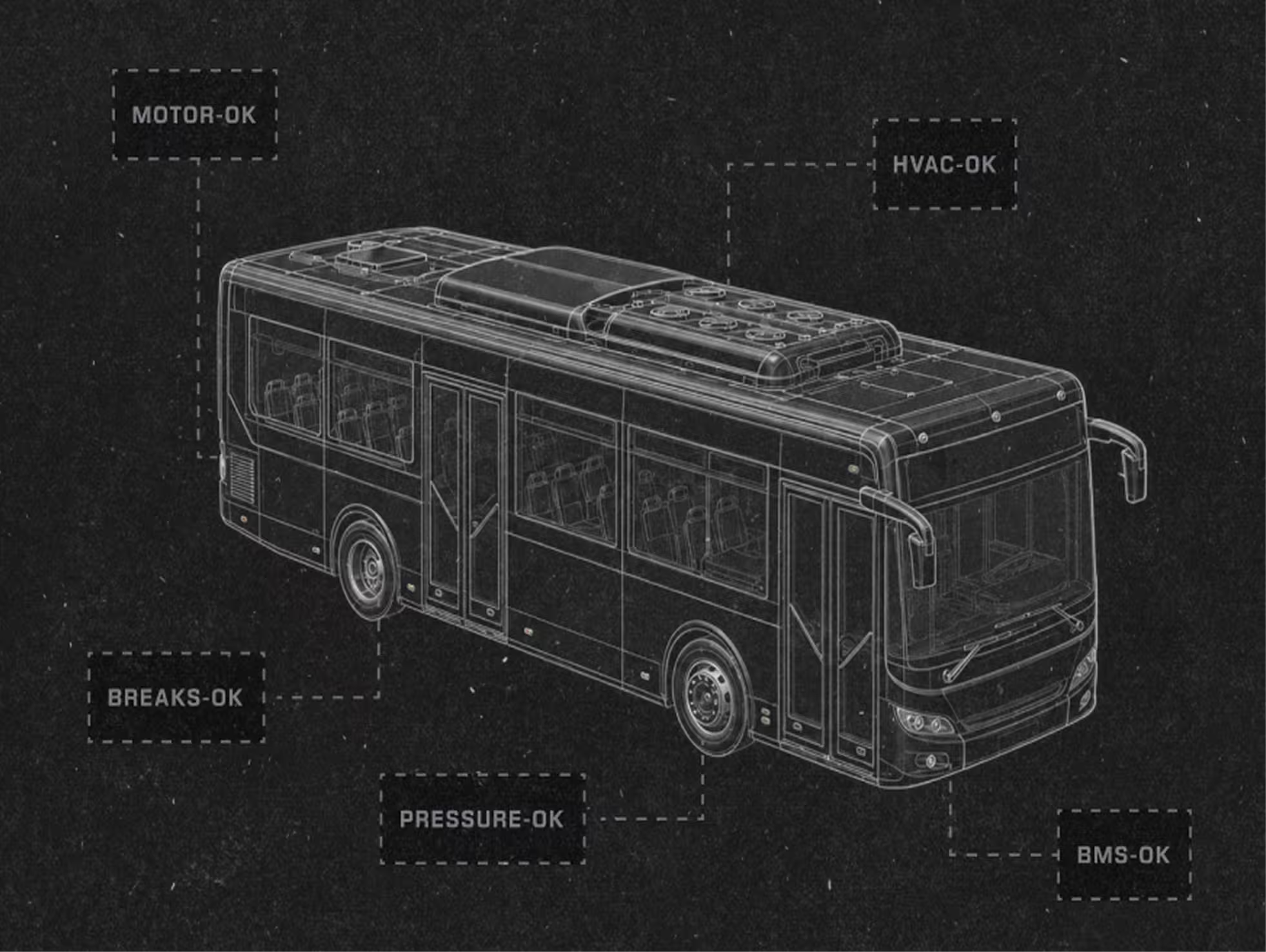
Why Stratio is built around the whole life of a fault: preventing it, diagnosing it, proving the fix and learning from what gets through.
A driver reports an issue, then the hunt begins
A driver reports something at the end of a shift. The bus comes into the workshop. Someone connects a diagnostic tool and starts working through what is there: fault codes, vehicle history, the driver’s note, the symptoms, the components that could explain them. Only when that ends does the repair begin.
The investigation takes most of the engineer’s time. If the first inspection misses the cause, or the shift changes before the picture is complete, the loop starts again from the beginning. Meanwhile the bus is out of service and the spare that replaced it is not available for anything else.
The workshop is doing exactly what the available information allows. Most maintenance systems stop at the fault code, and a fault code is a symptom. It says something is wrong. It does not say what caused it, or where to start looking.
The fault did not start that morning either. An air leak grows a little every day. A cooling system runs slightly hotter every week. A 24V battery takes a little longer to recover after every start. None of that is visible in a single check. A walk-round with the bus standing in the depot is a photograph of one moment. The signals the bus produces, day after day, are the movie, and in the movie the fault appears weeks before anyone reports it.
The information arrives late, and in pieces
Public transport is a promise that the bus will be there. Whether that promise holds comes down to timing: how early somebody knows a bus is in trouble.
Today that knowledge arrives late and in pieces: a driver report, a fault code, a work order, an inspection sheet, an investigation after the event. Each one is a record of something that has already happened, and each sits in a different system, often with a different person. The whole picture does not exist anywhere: not on a screen, not in a system, not in one person’s head. So diagnosis stops and starts, and the bus stays off the road longer than it needed to.
Maintenance teams work hard with what they have. The problem is structural: they see the vehicle in fragments, and mostly after something has gone wrong.
A prediction is not a repair
Over the past decade, the industry turned to predictive maintenance as the answer. The idea is sound: detect a failure before it happens.
In practice, most systems detect a handful of failure modes, one here and one there, and the label does the rest of the work. And where the detection is real, a prediction on its own still changes very little. It is an alarm.
An alarm without a diagnosis sends a technician looking for the cause from scratch, which is the same loop as before, only earlier. A repair that nobody verifies leaves the team hoping the fault is gone. A failure that nobody investigates tends to come back, on the same bus or across the fleet.
That is why we believe predictive maintenance was never the point. Reliability is the point. That is the game. A prediction is one move in it, and it only counts if what follows works: knowing what the fault is, fixing it, and proving the fix held.
Preempt, Diagnose, Validate, Investigate
This is how we have built Stratio. Our Diagnostic AI reads deep signals across the electrical, thermal, pneumatic and mechanical systems of every bus, on the road, parked in the depot and on charge, and follows each fault through four steps.
Preempt. Catch failures before they disrupt service. A 24V battery approaching the end of its life is flagged while there is still time to replace it in the depot, not after the bus fails to start at five in the morning.
Diagnose. The bus should arrive in the workshop with the troubleshooting already done: the likely cause identified, the evidence behind it, and a clear starting point for inspection. The team’s time then goes into fixing rather than finding.
Validate. Know whether a repair delivered the intended result. When an air leak is fixed, the leak rate should return to its baseline. If it does not, the team knows before the bus goes back on the road.
Investigate. When something does get through, build a defensible record of what happened and why, from the vehicle’s own data. Each investigation feeds back into the maintenance plan and into the detection itself, so the same failure is less likely to start, and less likely to reach the road if it does.
Each step is useful on its own. Together they close the loop: faults are prevented where possible, fixed quickly and correctly when they appear, and understood when they slip through.
What changes for an operator
When the loop is closed, reliability stops being something an operator hopes for and becomes something it can plan, prove and protect.
The effect is measurable. At Arriva, towing fell by 66.6%, the spare fleet shrank by 25%, mean time between failures rose by 13.5% and the ratio of planned to unplanned maintenance improved by 33.3%. At SBS Transit in Singapore, on-road breakdowns fell by 20%.
Behind those numbers are changes that matter every day: fewer buses stranded on the road, fewer spare vehicles waiting on standby, workshops that spend their time repairing rather than searching, and a factual record to support performance reviews, contract renewals and warranty claims.
What we believe
Public transport is a promise that people can rely on their city, every day. That promise is kept or broken by buses that work when they are needed.
We believe buses should be understood as living systems: continuously, as a whole, and while they are in service. We believe maintenance should act on the real condition of each vehicle, not on the calendar alone. And we believe every repair should end with evidence, not hope.
That is what Stratio is built for: to give maintenance teams the movie instead of the pictures. So their time goes into repairing buses instead of working out what is wrong with them, and so reliability can be planned, proved and protected. Because when buses are reliable, cities move.